Klaipėda Drama Theater
Premiere: 2025
Director and Playwright: Laura Kutkaitė
Set Designer: Paulina Turauskaitė
Choreographer: Agnietė Lisičkinaitė
Costume Designer: Liucija Kvašytė
Composer: Arturas Bumšteinas
Sound Director: Edvinas Vasiljevas
Visual Artist: Eitvydas Doškus
Lighting Designer: Dainius Urbonis
Assistant Director and Assistant to the Dramaturg Alius Veverskis
Translated from English by Dovydas Grajauskas
Title Designer for Visual Materials Jurgis Griškevičius
Texts: Milena Jesenská, Franz Kafka, Laura Kutkaitė (in collaboration with the actresses)
Song lyrics: Milena Jesenská, Franz Kafka, Arturas Bumšteinas (in collaboration with the actresses)
Cast: Toma Gailiutė, Eglė Jackaitė, Digna Kulionytė, Samanta Pinaitytė, Justina Vanžodytė, Aistė Zabotkaitė
“Writing letters is like making love to ghosts,” wrote Franz Kafka. The play “Milena” is an attempt to shake off Kafka. But how do you shake off something you think you love? How do you shake him off when the whole world knows you precisely because he wrote you letters?
When Milena Jesenská offered to translate Kafka’s *The Lost One*, their correspondence soon turned into something entirely different. The letters not only reflect the stages of their relationship—they are the relationship itself. Although almost all of the letters* were written between April and November 1920, they met in person only twice during that time. What does such a relationship—driven almost entirely by the imagination—mean? On the other hand, aren’t we ourselves often in exactly such relationships, even though we communicate in person rather than through letters? And if we are, why do we love to lie to ourselves so much? How can we shake off that lie?
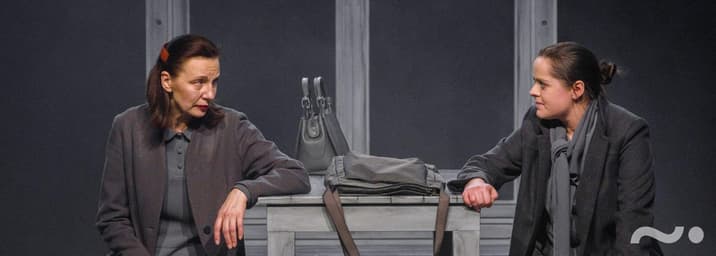
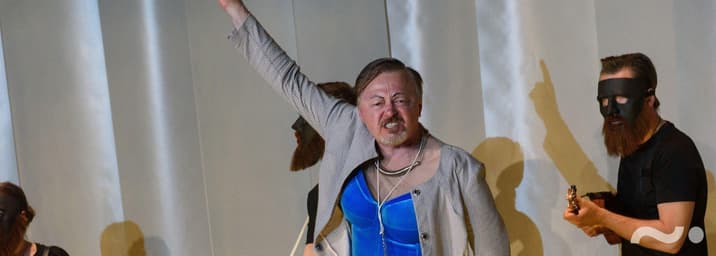
The play *Milena* does not claim to reconstruct the relationship between Milena and Kafka or to present a documentary portrait of Milena—it seeks to rethink this relationship through a kind of theatrical “editing” of fragments. Six actresses on stage—each of them is Milena, Kafka, and themselves, trying to talk to Milena, as well as editors arranging the chronology of a staged letter.
The director says that “Milena” will, after all, be a kind of courtship with ghosts, because it deals with what is not there, with what never fully existed. “Milena Jesenská’s personality inspires with her indomitable spirit, which cannot be destroyed—even when bodies, cities, and letters are destroyed. But what attracted me most was the very format of the letters and the fact that the chronology of the letters is pieced together by the editors, even though they don’t have all the dates and details. This means that the editors are performing a kind of ‘translation,’ and we are passing judgment on people’s personal affairs and evaluating them based on something that is never accurate. This “translation” through time—this public exposure and rearrangement of other people’s personal affairs at their own discretion—both angers and fascinates me. This montage-like format of letters creates a good stage for theatrical play. The performance is born out of improvisation; in such a letter, we send postcards through our own bodies. Perhaps we’re sending them to Milena. Perhaps to everyone who loves life just as it is. But probably most of all to those who know what it means to be alone even when surrounded by people, and yet to remain brave enough to keep on living,” – says L. Kutkaitė.
* Only Kafka’s letters to Milena have survived; Jesenská’s letters to Kafka were destroyed.
Milena Jesenská (1896–1944) was a Czech journalist, writer, translator, and resistance fighter. Milena was much more than just “Kafka’s love.” She was one of the most prominent journalists in interwar Czechoslovakia, actively participated in the anti-Nazi resistance, and was imprisoned in 1939 for her activities; she died in 1944 at the Ravensbrück concentration camp. Her body of work includes more than 1,000 articles, but only a few of them have been translated from Czech. These texts reveal her perspective on social and cultural changes as well as the threat of Nazism. Milena was a talented translator who contributed to the appreciation of Kafka’s work in the Czech Republic. Despite her connection to Kafka, Milena’s independent creative and moral authority is becoming increasingly relevant today.
Performance rated 14+
The performance uses smoke and bright flashes of light
The performance is in Lithuanian with English subtitles